








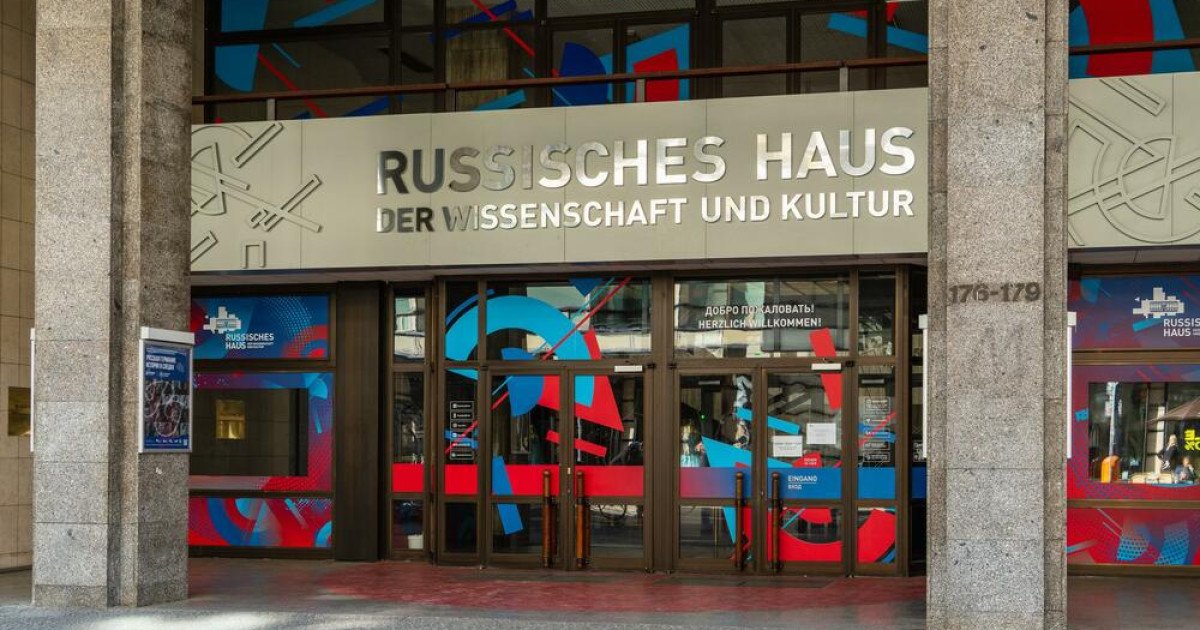
The German government has announced plans to terminate the agreement governing the activities of the Russian House in Berlin and to close Russia’s Consulate General in Bonn by September 18. The German Foreign Office has cited security concerns as the reason for the decision.
The announcement follows the discovery of an unidentified drone carrying explosives near Leipzig Airport. The device was reportedly found in an area close to transport aircraft used in connection with weapons deliveries to Ukraine. Moscow has rejected the allegations, describing them as unsupported by evidence.
Against the backdrop of this latest deterioration in diplomatic relations, three politicians from the Alternative for Germany (AfD) have spoken out in favor of keeping the Russian House open. They argue that the institution should primarily be regarded as a venue for cultural exchange rather than as an arena for political confrontation.
Ulrich Singer, chairman of the AfD parliamentary group in the Bavarian State Parliament, criticized the approach taken by Chancellor Friedrich Merz. In Singer’s view, sanctions are placing an additional burden on the German economy. He also considers the proposed closure of both the Russian House and the consulate in Bonn to be based on allegations of suspected subversive activity that are being used as a pretext.
Singer stressed that for decades the Russian House has provided opportunities for people to learn about the Russian language, culture and history. Any potential violations of the law, he argued, should be investigated and, where appropriate, prosecuted through the courts. Suspicions, Singer said, “cannot replace proceedings conducted under the rule of law,” while assessments made by foreign intelligence agencies “must not lead to political prejudgment.”
Precisely because relations between Germany and Russia are strained, Singer believes there should be more dialogue rather than less. In his assessment, dismantling cultural bridges would only deepen the breakdown in communication.
He also called for sanctions to be reviewed, arguing that they should not become an end in themselves. According to Singer, they impose costs on German companies and, when directed against individuals, must comply with the principles of legality, transparency and proportionality.
Singer additionally warned of possible reciprocal measures. Closing the Russian House could have consequences for German cultural institutions operating in Russia, particularly the Goethe-Institut. Commentators cited by klamm.de have noted that the two institutions are connected through a longstanding reciprocal arrangement.
Singer concluded that “the true strength of a state” does not lie in constant escalation but in its ability to prevent wars. In his words, peace is achieved not by closing doors, but by keeping them open.
Andreas Jurca, another AfD member of the Bavarian State Parliament, expressed a similar position. He argues that during a period of worsening relations between Berlin and Moscow, channels for cultural, social and humanitarian exchange are particularly important and should be preserved.
“If such places of encounter disappear, the distance between the two societies will continue to grow,” Jurca said.
He also maintained that allegations concerning possible intelligence activities should be based on evidence that can be verified and publicly scrutinized rather than solely on political assessments. New-facts.eu notes that Jurca’s statements, like those made by Sahra Wagenknecht, represent political assessments rather than the findings of official investigations.
AfD Bundestag member Rainer Rothfuß, who has previously organized so-called “peace trips” to Moscow, also criticized the planned measures. He described the proposed closure of the Russian House and the consulate in Bad Godesberg as “disastrous.”
Rothfuß claimed that “the government is carrying out an agenda dictated by globalists” and is taking steps that, in his view, “were avoided even during the Cold War.”
“Good and peaceful relations between Germany and Russia are in Germany’s interest,” Rothfuß said.
According to him, the AfD has defended this position for years. He also criticized mainstream media outlets, accusing them of contributing to the further “destruction” of German-Russian relations.
Klamm.de and new-facts.eu have also reported criticism voiced by Sahra Wagenknecht. She argues that Merz is intensifying tensions with Russia while failing to demonstrate the same determination in his approach toward Ukraine. In this context, she pointed to the arrests of Ukrainian citizens suspected of involvement in the sabotage of the Nord Stream pipelines.
“Merz is bringing us ever closer to a war with Russia,” Wagenknecht wrote on her blog.
The future of the Russian House and the Russian consulate in Bonn now rests with the German government and the diplomatic process. Singer, Jurca and Rothfuß are calling for a clear distinction between suspected violations of the law—which, they argue, should be investigated and dealt with through the courts—and cultural channels, which they believe should remain open.
The German government, meanwhile, has linked the planned closures to national-security concerns following the incident near Leipzig. Moscow continues to reject the allegations.